
A business website generates more customers when every page is built around what buyers search for and need to decide. That means clear service pages, a strong offer above the fold, genuine proof, short forms, obvious calls to action, and a CRM that triggers fast follow-up the moment someone inquires.
Picture two service companies in the same city. Both are good at what they do, both have years of experience, and both spend real money on Google and social ads every month.
The first sends all of that traffic to a generic homepage. Visitors see vague copy, no clear next step and no easy way to book a call, so they hit the back button and check a competitor.
The second sends traffic to focused service pages. Visitors instantly see who the company helps and what result it delivers, read real case studies, and book a call straight onto the team calendar. Within a minute of booking they get a confirmation and a short intake guide.
Same market, same budget, very different results. The difference is not the ad spend or the product. It is how the website is built to convert. A modern business website cannot be a passive online brochure. It has to work as a client acquisition system around the clock.

Why Do Most Business Websites Fail to Generate Customers?
Most companies spend on design and hosting, then wonder why inquiries stay flat. In our experience the problem usually comes down to six bottlenecks:
What Does a High-Converting Business Website Look Like?
Turning a static site into a customer engine means giving every page a job. Each part of the site should move the buyer one step closer to a decision.

| Website element | Typical brochure site | Conversion-focused site |
|---|---|---|
| Hero section | Vague slogans that say nothing | Outcome-based headline, who you serve and one clear call to action |
| Navigation | Crowded menus with dozens of links | Simple menu that leads to your core services |
| Service content | One long page of generic bullet points | A dedicated page per service with process, deliverables and FAQs |
| Lead capture | A basic contact page with an email link | Short forms, online booking and simple estimate tools |
| Social proof | Unnamed quotes hidden on a subpage | Named reviews, client logos and case studies with real results |
| Mobile experience | Desktop layout squeezed onto a phone | Mobile-first layout with tap-to-call and a sticky call to action |
| Lead handling | Inbox checked once a day | CRM record, instant alerts and automated first response |
Google uses mobile-first indexing, which means it mainly looks at the mobile version of your pages. A site that is hard to use on a phone loses both visitors and visibility.
How Do You Turn Website Visitors Into Clients?
A. Build a Dedicated Page for Each Core Service
Sending specialized traffic to a general homepage is one of the biggest budget leaks in marketing. A homepage is built for broad discovery. It cannot speak to the specific problem of each buyer.
Create a separate landing page for every core service. A commercial security company, for example, would build separate pages for access control, video surveillance and security patrols. Each page should focus on one problem, explain your process, show relevant proof and include a short inquiry form.
B. Write Calls to Action That Say What Happens Next
Buttons like Submit or Click Here give people no reason to act. Strong calls to action describe the benefit of the next step.
| Weak call to action | Stronger call to action |
|---|---|
| Submit | Request Your Custom Proposal |
| Learn More | Book a 15-Minute Audit Call |
| Contact Us | Get Your Project Estimate |
| Send Message | Claim Your Free Strategy Session |
Place your main call to action above the fold on desktop and mobile, then repeat it at natural decision points further down the page.
C. Add Simple Self-Service Tools

Many buyers prefer to get answers on their own before talking to sales. Tools such as a project estimator, a service scope builder or a short qualification quiz give them instant value.
When a prospect finishes a short estimator, they get a rough scope right away, and your team gets useful details about their timeline and requirements before the first call.
D. Show Real Proof With Case Studies
Bigger B2B decisions are about reducing risk. Before signing, buyers want proof that you can deliver. Replace generic praise with short, specific case studies built in three parts:
Only publish results and reviews you can back up, and get client permission first. The FTC banned fake reviews and testimonials in 2024.
E. Connect Every Form to a CRM

An inquiry is worth nothing if it gets buried in an inbox. Connecting your website forms to a CRM makes every lead visible and owned. When someone submits a form, the CRM can create the contact, tag the traffic source, score the lead, assign it to the right person and set a follow-up task. This is the core of the CRM and AI automation systems we set up for clients.
F. Follow Up Fast With Automation
Speed matters. Research published in Harvard Business Review found that firms contacting online leads within an hour were nearly seven times as likely to qualify them as firms that waited even one hour longer.
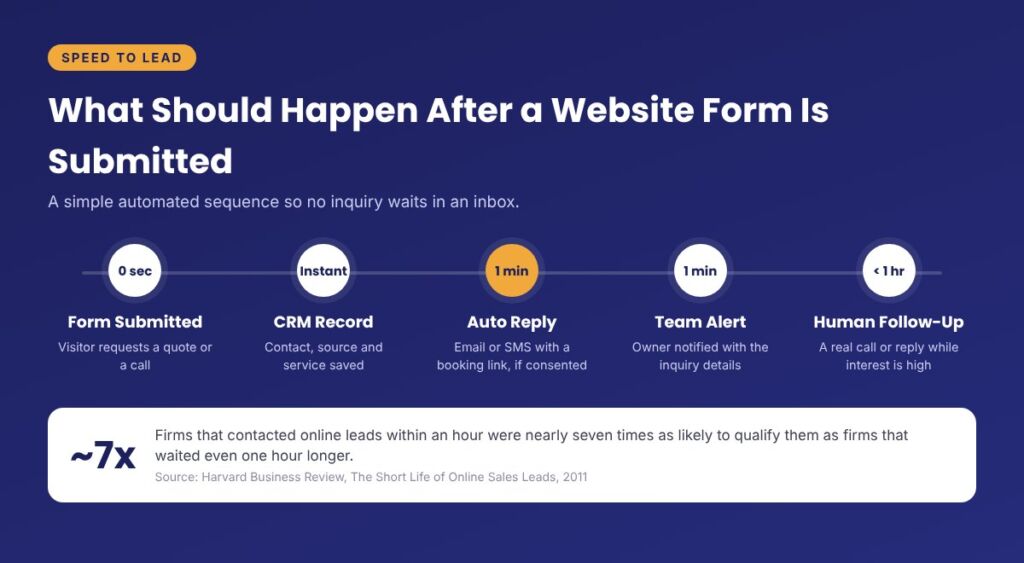
- Instant confirmation email: a personal message with a booking link and next steps.
- SMS confirmation: a short text confirming you received the request, only when the person opted in.
- Team alert: a notification in Slack or your CRM app with the inquiry details so someone can call back quickly.
Want a website that books calls on its own?
Book a free strategy call with Medinyl CEO Abdul Rehman. The call is free and there is no obligation.
How Do SEO and AI Search Bring the Right Visitors?

A converting website still needs the right visitors. Search engine optimization (SEO) helps you appear in Google, and generative engine optimization (GEO) helps your business show up in AI answer tools such as ChatGPT, Perplexity and Gemini. Google’s own SEO Starter Guide covers the basics, and our guide to generative search engine optimization for small businesses covers AI search.
Target Buying Intent, Not Just Information
| Query type | Example | Value for lead generation |
|---|---|---|
| Informational | what is cloud hosting | Low. The person is still learning |
| Commercial | best cloud migration agency | High. The person is comparing vendors |
| Local commercial | IT support company in your city | High. The person wants a nearby provider now |
Optimize your service pages for commercial searches so you reach buyers at the moment they are choosing a provider.
Win Local Searches
If you serve specific cities or regions, build genuinely useful location or service-area pages, keep your name, address and phone consistent everywhere, and keep your Google Business Profile accurate. Google says local results are based mainly on relevance, distance and prominence.
Which Pages Does a Customer-Generating Website Need?
| Page | What it does for customer acquisition |
|---|---|
| Homepage | States your value, who you serve and routes visitors to the right service page. |
| Service landing pages | Explain each solution, deliverables, process and next step, with a short inquiry form. |
| Case studies and results | Show real proof: named reviews, client results and credentials. |
| About and leadership | Build trust by showing the people, history and values behind the business. |
| Contact and booking | Offer a short form, online booking, phone, location and expected response time. |
Want the bigger picture first? Read our guide on why every business needs a professional website.
How Does Medinyl Build Websites That Generate Customers?

At Medinyl, we believe a website should be a revenue asset, not a design expense. Many businesses run campaigns and redesign their sites, yet still struggle with uneven pipeline and untracked leads. The cause is almost always disconnected tools.
See how this works for specific industries in our guides for roofing contractors and real estate agents.
Ready to turn your website into a customer engine?
Book a free strategy call with Medinyl CEO Abdul Rehman. We will review your current setup, find the leaks and give you a clear plan. Prefer to write in? Use our contact page.
Frequently Asked Questions
How can a business website generate more customers?
By matching what buyers search for, explaining your value clearly, showing real proof, keeping forms short and following up fast through a CRM.
What makes a business website high-converting?
A clear message above the fold, specific calls to action, fast mobile pages, a dedicated page for each service, real client results and easy booking.
Why is a homepage alone not enough to win clients?
A homepage serves broad navigation. Dedicated service pages speak to one specific problem and give a direct next step, which usually converts better.
How does CRM integration improve website lead conversion?
It logs every submission instantly, tags and scores the lead, alerts the right person and starts follow-up, so no inquiry is delayed or lost.
Can local SEO help a service business win nearby clients?
Yes. Accurate service-area pages, consistent business details and a well-kept Google Business Profile help nearby buyers find and contact you.