
Real estate agents need their own website to build trust, show their services and get more inquiries online. Brokerage pages and portal profiles are not fully yours. Your own site is: you control the design, the message and how you collect leads, and you can connect it to local SEO, valuation forms and a CRM.
A past client tells a friend about you. The friend wants to buy or sell a home. They mention your name and share their good experience. But before they call you, they do one thing first: they search for you on Google.
What they find next matters a lot. If they see a clean website with your services, client reviews, property details and an easy way to contact you, they feel safe. If they find almost nothing, they may call another agent.
So, why does a real estate agent need a website? It does more than put you online. It helps people trust you, brings you new buyers and sellers, helps people find you on Google, and gives you a steady way to get more leads.
Do Real Estate Agents Really Need Their Own Website?
Yes. Most agents gain a lot from having their own website, especially if you want people to know your name and you want leads coming in all year.
Agents are still central to the deal. According to the National Association of REALTORS 2025 Profile of Home Buyers and Sellers, 88% of buyers and 91% of sellers used an agent or broker. The question is not whether people hire agents. It is which agent they pick, and that choice often starts online.
Think of someone looking for a home in your area. They search Google for a local agent, compare a few names, read reviews and visit websites. Then they decide. If you have no website of your own, you may never make that shortlist.
Referrals are great, but if you only depend on them, you reach fewer new people. A good website lets visitors learn about your experience, see your services, browse homes and contact you.
A website should not just make you look nice. It should bring in new prospects and turn their interest into real inquiries. That is why it helps your business grow for years.
Is a Brokerage Page or Zillow Profile Enough?
Brokerage websites and portals such as Zillow can help you show up online. Your brokerage may give you a page with your name, photo, phone number and listings. Property sites also help buyers and sellers find agents. But these platforms decide the design, the features and how visitors use the page. You do not.
| Feature | Brokerage page | Zillow profile | Your own website |
|---|---|---|---|
| Brand control | Limited | Limited | Full control |
| Website design | Ready-made template | Set by the platform | You decide |
| Getting leads | Depends on the brokerage | Depends on the platform | Your own forms and tools |
| Personal brand | Limited | Limited | Full freedom |
| Local SEO | Limited | Depends on the platform | More control |
| CRM connection | Depends on the provider | Depends on the features | Easy to connect |

You do not have to stop using brokerage pages or property sites. They still help people see you. But your own website gives you one more place to build trust, without depending only on platforms that can change their rules at any time.
What Do Buyers and Sellers Look for Before Contacting an Agent?
People want to know three things. Can I trust this agent? Does this agent have experience? Does this agent know my local area? Your website should answer these questions before the visitor ever calls you.

What Do Home Sellers Check Before Choosing an Agent?
Sellers want to know how you will help them sell their home. They may look for:
- Homes you sold before and what those clients said.
- Reviews from other homeowners.
- Your knowledge of the local market.
- A clear plan to market their home.
- A simple explanation of how selling works.
- An easy way to ask for a home value.
A dedicated seller page answers these questions and makes homeowners more likely to book a consultation with you.
What Do Home Buyers Look for When Searching for an Agent?
Buyers often need extra guidance, especially first-time buyers. They may want to know:
- Which neighborhoods you work in.
- Whether you understand the kind of home they want.
- What homes are available right now.
- How the buying process works.
- Whether you have helped people like them before.
- How to book a meeting with you.
When your website gives this information, it becomes genuinely useful, and people have a reason to contact you.
How Can a Real Estate Website Help Generate More Leads?
A real estate website can bring in a lot of new business when it is built around what buyers and sellers need. Getting visitors is only step one. The real goal is to turn visitors into inquiries, and inquiries into clients. That is why you need a clear lead generation plan.
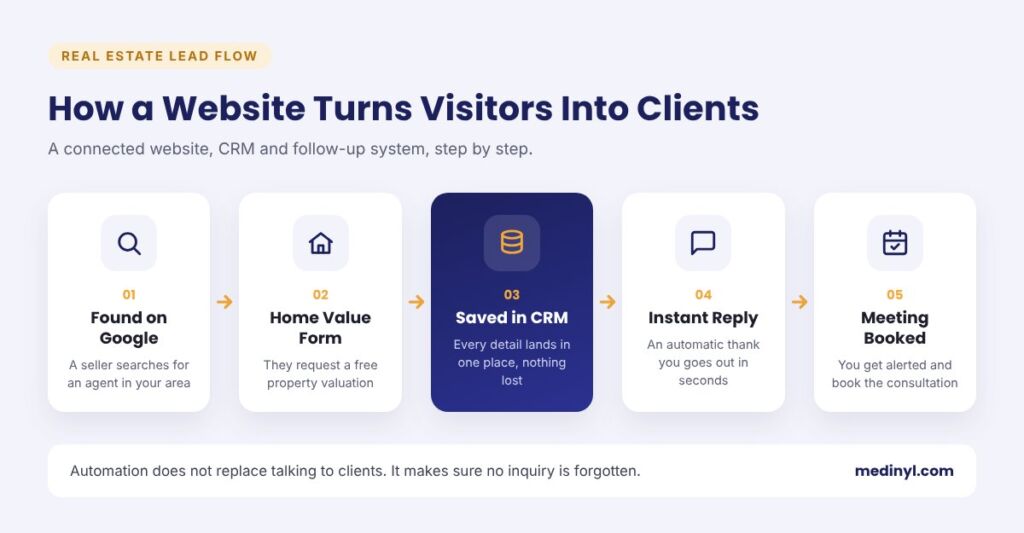
No website can promise a fixed number of leads. Results depend on your traffic, how easy the site is to use, your market and how fast you respond to each inquiry.
How Can Your Website Help You Show Up on Google?
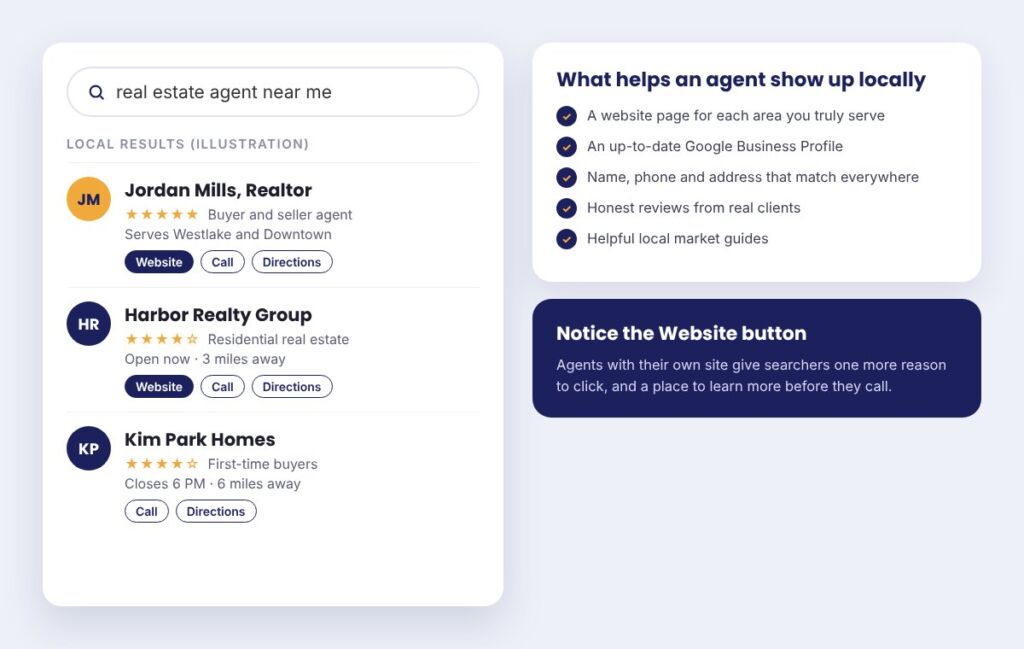
Google can bring you people who are looking for an agent right now. They may search for a real estate agent in Austin, a realtor near me, or homes for sale in a specific neighborhood. If your website clearly shows your services and the areas you cover, it has a chance to appear in those searches. This is where local search engine optimization (SEO) helps.
How Does Local SEO Help Real Estate Agents?
Local SEO helps people in your area find you. For agents, it means:
- Creating useful pages for each area you serve.
- Writing clear page titles and descriptions.
- Publishing helpful local market guides.
- Keeping your business details consistent everywhere.
- Collecting honest reviews from real clients.
- Keeping your Google Business Profile up to date.
Do not duplicate the same page and swap in different city names. Google lists pages built only to target cities and funnel visitors as doorway abuse in its spam policies. Every area page needs real, local information.
Why Should You Connect Your Website With Google Business Profile?
Your Google Business Profile helps you appear in Google Search and Google Maps, with your reviews, phone number and website link. Google says local results are based mainly on relevance, distance and prominence. Make sure your profile details match your website and other listings so the two support each other.
Remember, a website will not make you rank first overnight. It takes time and depends on how useful your site is and how strong the competition is. As more people ask AI tools for recommendations, it also helps to understand generative search engine optimization for small businesses.
What Should a Real Estate Agent Website Include?
A good real estate website does not need dozens of pages. It needs the right information and tools so visitors understand your services and can contact you easily.
Which Pages Should Every Real Estate Website Have?
| Page | What it should do |
|---|---|
| Homepage | Say who you are, what you do and where you work. |
| About | Share your background, experience and how you help clients. |
| Buyers | Explain how you help people find and buy a home. |
| Sellers | Explain how you price, market and sell homes. |
| Property listings | Show homes for sale with clear details and photos. |
| Reviews | Show real client feedback, shared with permission. |
| Contact | List your phone, email, contact form and service areas. |
Which Features Help Generate More Real Estate Leads?
- Property valuation request forms.
- Buyer and seller inquiry forms.
- Click-to-call buttons.
- Online meeting booking.
- CRM connection.
- Instant alerts for new inquiries.
- A layout that works well on phones. Google uses mobile-first indexing, so your mobile site is what it mainly evaluates.
- Fast loading pages.
- Helpful local property guides.
You do not need everything on day one. Start with what your business needs and add more as you grow.
Want a real estate website that brings in leads?
Book a free strategy call with Medinyl CEO Abdul Rehman. The call is free and there is no obligation.
Can Real Estate Agents Generate Leads Through Social Media Without a Website?
Yes. Many agents use Facebook, Instagram and LinkedIn to meet new clients, share listings and promote their work. Social media is great for building an audience. But if you depend only on it, you do not control the platform rules, who sees your posts, or what visitors experience when they click.
Your website is the one place you own. The best approach uses both: share a neighborhood guide on social media, send interested people to a page on your site with more detail, and let them book a meeting from there. That way social media and your website work as one lead generation system.
What Website Mistakes Should Real Estate Agents Avoid?
A website can look beautiful and still bring in no inquiries if key parts are missing. Watch out for these:
How Much Does a Real Estate Agent Website Cost?
The cost depends on size, design and features. A simple site with a homepage, about page, services and contact details takes less work. A custom site with property search, CRM connection and automated lead handling takes more.
| Cost factor | What affects it |
|---|---|
| Number of pages | More pages mean more design and content work. |
| Custom design and branding | Unique layouts and branding take extra time. |
| Property listing features | Search filters and listing pages add development work. |
| IDX connection, where available | IDX pulls live listings from your MLS onto your site. |
| Lead forms | Buyer, seller and valuation forms. |
| CRM and automation | Connecting lead management and follow-up systems. |
| SEO setup | Technical SEO and on-page optimization. |
| Hosting and maintenance | Ongoing hosting, updates and security. |
Do not choose a website only because it is cheap. Ask what it must do for your business: more people finding you, better conversations with clients and more leads.
Where Should You Start If You Do Not Have a Real Estate Website?
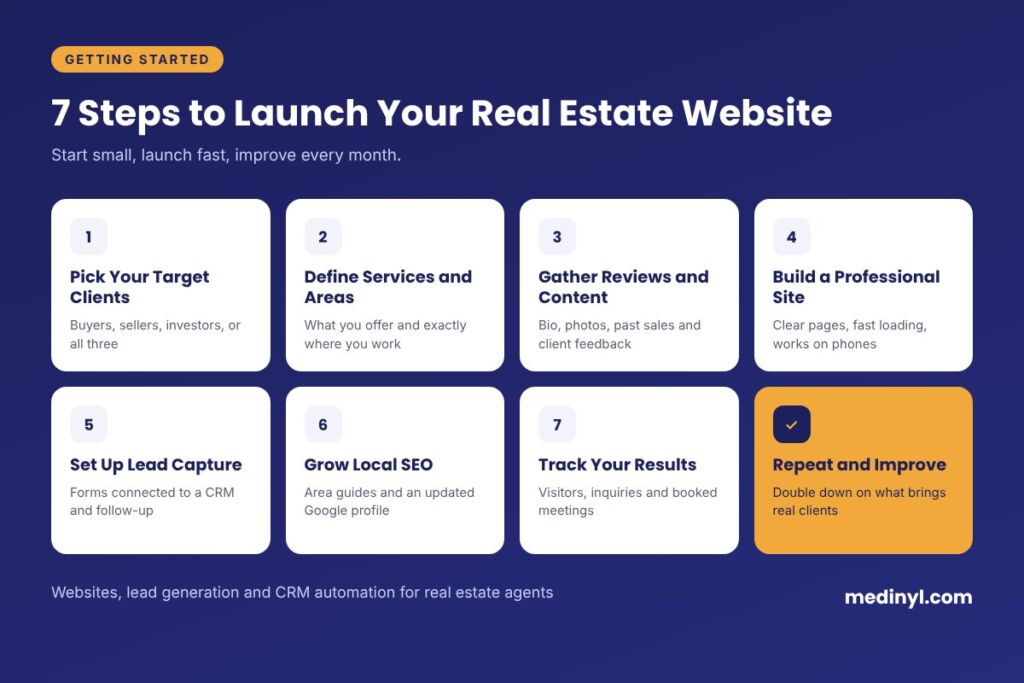
Building a website can feel hard when you start from zero. Take it one step at a time.
| Step | What to do |
|---|---|
| 1. Pick your target clients | Decide who you want most: buyers, sellers, investors or all three. |
| 2. Define services and areas | Say clearly what you offer and where you work. |
| 3. Gather reviews and content | Prepare your bio, photos, past sales and client feedback. |
| 4. Build a professional site | Make it easy to understand your services and contact you. |
| 5. Set up lead capture | Connect your forms to a CRM so every inquiry is saved and answered. |
| 6. Work on local SEO | Publish helpful local content and keep your Google profile current. |
| 7. Track your results | Watch visitors, inquiries, booked meetings and lead sources. |
How Can Medinyl Help Real Estate Agents With Lead Generation?

At Medinyl, we believe a website should do more than display information. It should help you find new clients and turn them into real conversations.
Many agents already have a website, social media pages and listings, yet still struggle to get steady leads or handle inquiries on time. Usually the problem is not a lack of marketing. It is that nothing connects everything together. We fix that.
Want to see how this could work for you? We will look at what you have today, show you what can be better and tell you honestly what makes sense for your business. Learn more about Medinyl.
Is a Website Worth the Investment for a Real Estate Agent?
Yes. A professional website is a smart investment for agents who want to build trust, be seen online and win more clients. It gives you control over your online presence and helps you reach buyers and sellers who are searching for an agent right now.
When your website is connected to lead forms, a CRM and follow-up tools, it becomes a core part of your lead generation system. You do not need a big, complex site to begin. Build something useful, easy to use and focused on what your clients need.
Running a home service business too? See our guide on why a website is necessary for a roofing contractor.
Ready to build a better lead system for your real estate business?
Book a free strategy call with Medinyl CEO Abdul Rehman. No cost, no pressure. Prefer to write in? Use our contact page.
Frequently Asked Questions
Do real estate agents need a website if their brokerage provides one?
Yes. A brokerage page helps you show up online, but your own website gives you more control over your brand, content, services and how you collect leads.
Can a real estate agent generate leads without a website?
Yes. Agents get inquiries from referrals, social media, property portals and networking. But a professional website is the one place you own to show your services, collect inquiries and grow leads over time.
How can real estate agents generate more leads online?
Use local SEO, useful website content, property valuation forms, separate buyer and seller landing pages, social media marketing and a fast follow-up system.
What is real estate lead generation?
It is the process of finding people who may want to buy, sell or invest in property and who may want to work with an agent. It can use websites, online ads, referrals, social media and other channels.
How does a real estate website help with lead generation?
A website explains your services, shows properties, builds trust and gives people forms or booking links to contact you. Connected to a CRM, it also saves and organizes every inquiry.
Should real estate agents use a CRM?
Yes. A CRM stores contact details, tracks conversations, organizes inquiries and reminds you to follow up. It is especially helpful when leads come from many places.
Does local SEO help real estate agents get clients?
Yes. Local SEO helps you appear when people search for real estate services in your area. A well-built website and an accurate Google Business Profile make you easier to find.
What should a real estate agent website include?
At minimum: a homepage, about page, buyer and seller pages, property listings if needed, real reviews and a contact page. Lead forms and a CRM connection make it stronger.
How much does real estate lead generation cost?
It depends on your marketing channels, market, competition, ad budget and the services you use. Website building, SEO, paid ads and CRM automation each have different costs.
Can website automation help real estate agents manage leads?
Yes. Automation can send thank-you messages, save contact details, alert you about new inquiries and help with follow-ups. It cuts manual work and keeps lead handling organized.