
Every business needs a professional website because it is the one place online you fully control. It explains what you offer, builds trust with real proof, helps people find you in search, and gives visitors a clear way to inquire. Connected to a CRM and fast follow-up, it becomes a steady source of qualified leads.
A potential customer hears about your business from a friend, sees your name in a search result, or comes across one of your social media posts. Before getting in touch, they search for you online to see what you do and whether you look credible.
What they find shapes their next step. A clear, up-to-date website gives them a place to understand your services, see genuine proof of your work and contact you. If they find outdated information or nothing useful, they keep comparing other providers.
So, why does every business need a professional website? Because it supports the core parts of growth: building trust, explaining your offer, helping people find you in search and turning relevant visits into inquiries. A website does not guarantee rankings or leads on its own. Results depend on your offer, content, user experience, traffic and follow-up.

Do Businesses Really Need Their Own Website Today?
For most businesses that want to be found and evaluated online, a website is a practical long-term investment. That includes professional service firms, local service providers, consultancies, clinics and online stores. Social media and referrals introduce people to your business. Your website gives them a central place to check the details.
| Step | What the customer does |
|---|---|
| 1. Need | Realizes they need a product or service. |
| 2. Discovery | Searches online, asks for recommendations or sees a business mentioned. |
| 3. Comparison | Compares providers, reviews services and looks for proof they can trust. |
| 4. Contact | Reaches out to the business that looks relevant and makes the next step clear. |
At Medinyl, we see a business website as more than an online brochure. It should help a visitor understand the offer and take a useful next step, whether that is requesting a quote, booking a consultation, calling or asking a question.
Is a Social Media Page or Directory Listing Enough?

Social profiles and directory listings help people discover a business, but they do not give you the same control as your own website. Third-party platforms set their own layouts, features, policies and reach. A website lets you control your pages, brand, calls to action and integrations.
| Capability | Social profile | Directory listing | Business website |
|---|---|---|---|
| Brand presentation | Limited to platform format | Limited to listing format | Full design and content control |
| Lead capture | Messages and platform forms | Calls or platform inquiries | Custom forms and booking flows |
| CRM connection | Depends on platform tools | Depends on provider | Connects through supported integrations |
| Search content | Profile and posts | Directory-controlled page | Your own service and resource pages |
| Customer data | Subject to platform rules | Subject to provider terms | Managed under your own privacy policy |
These channels work best together. Social posts, referrals and directory profiles introduce people to you, while your website gives them the full picture and one consistent place to inquire. Owning a website also means you are responsible for protecting the personal information people submit.
What Do Customers Check Before Hiring a Business?

Before contacting a provider, people want to know whether the business is relevant, credible and able to help. Make these details easy to find:
- A clear explanation of your services and who they are for.
- Examples of work or case studies you have permission to share.
- Genuine testimonials and reviews, presented accurately.
- A real introduction to the team or owner.
- A clear description of your process, service area and next steps.
- Easy ways to ask a question, request a quote or book a call.
Avoid claims like the best or guaranteed results unless you can prove them. Specific, verifiable details persuade more than broad marketing language, and the FTC banned fake reviews and testimonials in 2024.
How Does a Website Turn Visitors Into Qualified Leads?

Traffic only matters when it reaches the right audience and gives them a relevant next step. Website lead generation means attracting suitable visitors, helping them understand your offer and making it easy to inquire. For the full step-by-step playbook, read how a business website can generate more customers.
Want your website to bring in qualified leads?
Book a free strategy call with Medinyl CEO Abdul Rehman. The call is free and there is no obligation.
How Can a Website Attract Organic Traffic From Google?

Search engine optimization (SEO) helps search engines understand your website so it can appear for relevant searches. Use the words your customers use, explain your services clearly and publish genuinely useful pages. Google’s SEO Starter Guide is a good free starting point. Ranking is competitive, and adding keywords alone will not guarantee it.
Why Does Local SEO Matter for Service Businesses?
If you serve specific towns or cities, explain those service areas accurately, keep your business name, address and phone consistent, and maintain an accurate Google Business Profile. Google says local results are based mainly on relevance, distance and prominence.
Do not create near-identical pages that only swap the city name. Google lists pages built to target regions and funnel visitors as doorway abuse in its spam policies.
How Long Do SEO Results Take?
A new page has to be crawled, indexed and evaluated, and there is no fixed timeline. Competition, site history, content quality, technical setup and links all affect visibility. Requesting indexing helps discovery but does not guarantee a position. AI search is changing discovery too, which is why we wrote a guide on generative search engine optimization for small businesses.
What Should a Professional Business Website Include?
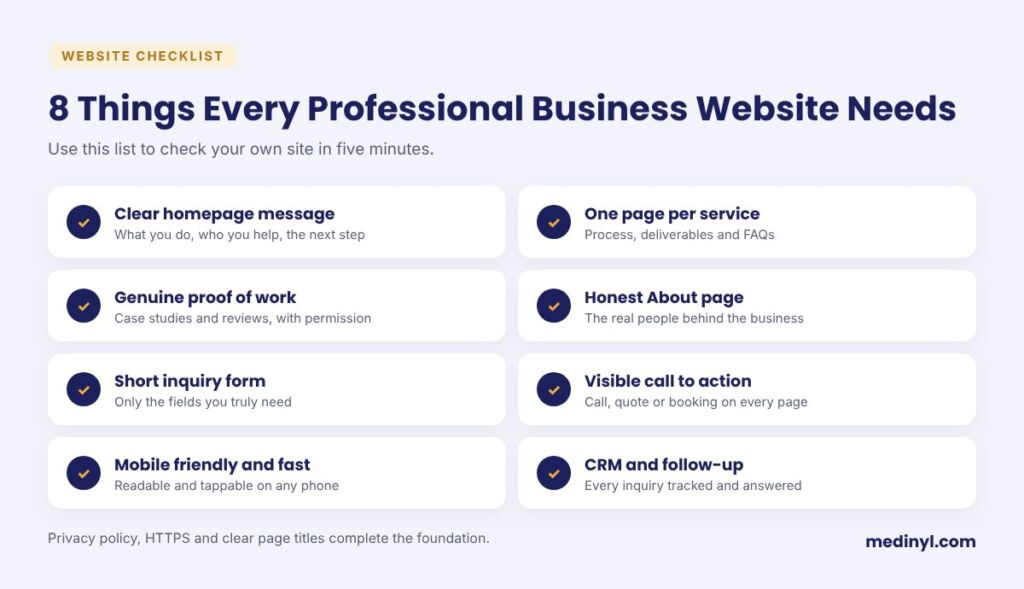
| Element | What it should do |
|---|---|
| Homepage | State what the business does, who it helps and the main next step. |
| About page | Introduce the business and its people accurately. |
| Service pages | Explain each service, deliverables, process and FAQs. |
| Proof of work | Show genuine case studies, portfolio examples or testimonials with permission. |
| Contact page | Provide working contact details and a simple inquiry option. |
| Privacy information | Explain how submitted personal information is handled. |
| Mobile-friendly design | Readable and usable on phones. Google uses mobile-first indexing. |
| Technical basics | Secure HTTPS, descriptive page titles, crawlable links and a clear structure. |
What Website Mistakes Should Businesses Avoid?
How Can Medinyl Help You Build a Better Lead System?

At Medinyl, we believe a business website should support a clear customer journey, not just look good. A visitor should understand the service, see why it fits and take the next step without friction.
Each piece has a job: the website explains the offer, landing pages focus on one audience or campaign, forms capture inquiries, the CRM organizes them and automation handles notifications and follow-up tasks.
Want to see this applied to a specific industry? Read our guides for roofing contractors and real estate agents, or learn more about Medinyl.
Is a Professional Website Worth It?
For businesses that want to be found, understood and contacted online, a professional website is a valuable foundation. It gives customers a place to learn about your services and gives you control over how your offer is presented.
Its value grows when it is built around a clear customer journey: useful service pages, simple inquiry options, a CRM and timely follow-up. These pieces support lead generation, but results depend on reaching the right audience and improving the experience over time.
Want to improve how your website attracts and manages inquiries?
Book a free strategy call with Medinyl CEO Abdul Rehman to plan a practical website and lead generation setup. Prefer to write in? Use our contact page.
Frequently Asked Questions
Why does every business need a professional website?
It gives customers one central place to understand your business, review your services and contact you. It also supports search visibility and lead capture when it is useful, accessible and kept up to date.
Can a small business generate leads without a website?
Yes. Referrals, social media, marketplaces and networking can bring inquiries. A website adds a channel you fully control, built around your services and inquiry process.
How does a website help with lead generation?
It attracts relevant visitors through search and other channels, explains your offer and gives people forms, calls or booking options. Connecting it to a CRM and follow-up process helps you manage every inquiry.
What is website lead generation?
It is the process of attracting relevant visitors and encouraging interested people to share their details or contact your business about your products or services.
Why should a business connect its website to a CRM?
A CRM organizes inquiries, records interactions, assigns follow-up and tracks progress, so no lead is forgotten.
Can automation help businesses follow up with leads?
Yes. Depending on your tools and consent rules, automation can send confirmations, alert a team member, create follow-up tasks and keep records organized.
Does having a website guarantee Google rankings?
No. Rankings depend on relevance, usefulness, competition, technical accessibility and many other factors. No agency can guarantee a specific organic position.
How long does it take for a new page to rank?
There is no fixed timeline. A page must be discovered, indexed and evaluated, and competition, site history and content quality all affect how quickly visibility grows.